
TENANT HORIZON ISSUE #11
- Valley Tenants Union

- Jan 26
- 15 min read


Updates
What is VTU?
Valley Tenants Union is building poor and working-class power, block-by-block, in the so-called Phoenix Metro area. Landlords organize to profit off unlivable conditions, to get away with their abuses, to raise our rents, to displace us from our homes and even the streets, so we organize as tenants, housed and unhoused. The change we need, a revolutionary transformation of housing into a world without rent, comes from us.
We organize with the people and not for the people. VTU is autonomous and grassroots - we’re not interested in grants, charity from wealthy donors, working with politicians, and the control they impose. Since the laws serve our exploiters and enforcement means carrying out the violence of eviction, we reject collaboration with the police. Solidarity is our strength, so we strive to unite with interconnected struggles against racism, capitalism, and imperialism.
How does that look in practice? Union-wide, we have monthly general assemblies and committees focused on specific domains, like eviction defense. Otherwise, we’re primarily organizing tenants associations in our residences, committees across the block, and locals spanning our neighborhoods. Why? To build deeply rooted power, we need to bring the movement home and connect our homes to the broader movement.
✮✮✮
Upendo Umoja
November was a rainy month, and that made for fertile ground for Upendo Umoja Tenants’ Association to grow! As mentioned in last month’s newsletter, there’s a need to share our wins with others to work through a sense of hopelessness or resignation. The core members of Upendo Umoja have seen that organizing can help us change conditions, and we as VTU members know that, but we need to bring those stories to people facing similar issues so that they learn from those experiences too (even if indirectly). In order to begin resolving that by connecting with more tenants, we knocked doors over a weekend to invite neighbors to our next meeting. We followed this up with knocking the doors of interested people again 30 minutes before the meeting, and this resulted in 4 new tenants joining us! Additionally, another tenant started attending again after management backed off upon hearing she’d been attending tenant meetings.
One area for growth, as well as a widely-felt issue, continues to be language justice. We pretty consistently have interpretation available for French and Arabic (and Spanish, if needed), but many tenants speak Swahili, Somali, and other African languages that we’re not able to translate. Interpretation all comes from the residents themselves, but as of yet we’ve struggled to consistently connect with some tenants and their family members who could help with language justice. Part of this is also due to people having different schedules that may not line up with our meeting time, which goes back to developing an organizing strategy with the residents to bring in people without them needing to attend the meetings. Unsurprisingly, translation of documents is still not offered to any tenants on management’s side of things—a huge issue when they contain important information, like renewing a lease in excess of 80 pages written in a language you may not understand. To this end, and to put pressure on the property manager to meet with tenants collectively, we started off December by planning to send an email with widely felt issues to property management proposing a date to meet and discuss them. We’ll bring the meeting to him if need be! We also planned to have an informational event to get connected with more neighbors, share victories so far, and plan to address issues. Although it’s cooling down, we plan to turn up the heat on landlords!
We welcome any feedback, and as always please reach out if you’d like to support our organizing or take on landlords in the West Valley by calling or texting us at 480-861-8459. Go tenants!
Downtown Local

In November, Downtown Local continued our struggle for unhoused and housed tenant dignity. We collectively decided upon principles of unity:
1. Stupid landlords: land ownership is the root issue
2. Property is theft
3. Housing shouldn’t be a commodity
4. Control over the park should lie with the tenants that live in and care for it
5. Each one teach one: we can combat ignorance by learning, growing, and organizing together
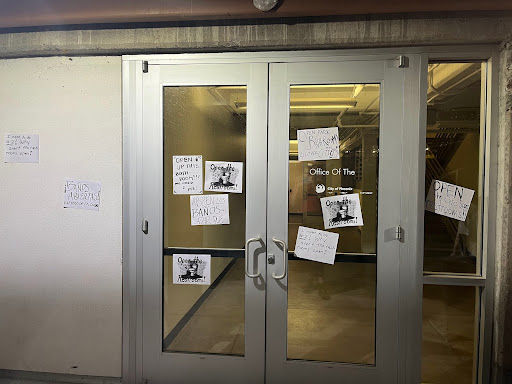
We discussed the stakes of our fight for a public restroom. Like other restrictive conduct policies and anti-homeless legislation, the closed bathroom serves as a pretext for police and rangers to harass, banish, and incarcerate unhoused tenants who use the bathroom outside. On November 22nd, a group of us disrupted a Phoenix Parks and Recreation public meeting at Old Canal Crosscut Park to push for an answer on our demand letter and call for all Phoenix park restrooms to be open. Our disruption did result in a response from the Downtown Division of Parks and Rec to further discuss the Civic Space bathrooms. In addition to the bathroom struggle, we continued our political education by reading another chapter from Take Back the Land and Inside LA’s Homeless Industrial Complex by LATU comrade and Abolish Rent author Tracy Rosenthal.
December organizing was heavy and ever-shifting in Downtown Local.
YMCA Organizing
At the beginning of the month, at least 5 tenants were evicted from the neighboring YMCA with no certain housing in the transition. Three of these tenants were Downtown Local members. We held a YMCA Tenants Press Conference on December 7th outside the Y. Tenant testimonies included descriptions of abusive practices, staff and security harassment, and abrupt evictions. A Downtown Local Member spoke on oppression, colonization, and domination, drawing parallels between his experience in residential schools and the experiences of poor unhoused tenants who face continual banishment and abuse by the state and homeless service providers.
We in Downtown Local see these evictions as an act of class war. The Astra Skyscraper, a multi-million dollar project, is intended to be built on the YMCA parking lot in 2026. It is not unreasonable to deduce that YMCA closure is imminent, as one of the few public housing options in a rapidly gentrifying downtown. The morning after the Press Conference, one of the evicted tenants who organized the event was called by YMCA staff and threatened with litigation. We also heard from current tenants that staff played videos of the speeches to tenants in the hopes to discourage organizing.
In the weeks after the press conference, Downtown Local continued to shape our organizing strategy for the YMCA, struggling with having little to no organizing commitment from current tenants, with our core YMCA organizers all evicted. We had a meeting with evicted tenants to determine their demands and desires for justice. It was decided to wait on any further public organizing until we could get current YMCA tenant participation.
Tragically, one of the evicted tenants, our friend and comrade Lucus, passed away the week after our meeting. Downtown Local has been moving through our grief, and have yet to determine what organizing steps to take next. We hosted a memorial on December 21st at the park. It was remarkable how many tenants knew Lucus and remembered him fondly. Tears and laughs were shared. Many spoke on his persistence and stubborn, unconditional devotion to the things and people he loved. I find it difficult to write about this, so I will leave it at this: the world feels duller without Lucus. His absence is a palpable hole, in Downtown Local and beyond.

Bathroom Organizing
At Downtown Local’s invitation, the Downtown Parks Supervisor attended our meeting on December 14th. The meeting went as expected, with apparent sympathy yet no concrete commitment to opening the restrooms. We did learn more about the ownership and control over the park; as we had speculated, ASU has a tremendous amount of sway in the city-owned park, bankrolling the City of Phoenix Park Rangers’ salaries. We spoke for nearly an hour, with tenants sharing experiences and solutions, as well as a demonstrated commitment to steward the bathrooms on a volunteer-basis, negating any purported concerns on cleanliness and maintenance. The end result of the meeting is another meeting, on January 11th. We have discussed how to organize in response to a denial of the bathroom, as well as methods to apply pressure to the city to concede to our demands.
Transitional Housing

The union has been going to a local shelter in downtown. We’ve been giving food to the residents because of how poor the food is that they are served. The food is often raw or not cooked well. We’ve also been having organizing conversations there and uncovering other issues that they’ve been facing.
The shelter is run by St. Vincent De Paul, and the staff there are terrible. There are weird rules like only allowing one blanket and pillow per bed. Segregating dorms by gender, even for married couples. They can only use the showers at designated times. They can not use the computer room. They can not bring any tools for working on a bike or a car. Laundry detergent isn’t able to be taken in a bottle only in a plastic bag. They really limit the food that you can bring in. There are cameras and microphones recording the residents constantly inside their dorms. The staff also let some people break the rules, but not other playing favoritism. It is said that staff also confiscated items and then keeps them for themselves.
Ordinance G-7467

Downtown Local
This month, the Phoenix city council passed City Ordinance G-7467, also known as "Safe Medical Care in City Parks Ordinance” which makes it illegal for anyone, including health professionals, to give out drug use harm reduction kits (alcohol wipes, sterile syringes, drug testing kits) and conduct safe needle exchanges. The ordinance also prohibits any medical care in parks unless the event is “authorized by the city” or if it is in response to a medical emergency. The ordinance also lists the distribution of Naloxone/Narcan as an exception to the prohibition. The ordinance was passed by the city council but the effective date was delayed to the end of March 2026 due to backlash.
The ordinance is left intentionally vague so the city can potentially criminalize any healthcare for unhoused tenants. It is similar to the recent criminalization of safe abortion in many states. The wording is left intentionally vague making it potentially illegal for healthcare professionals to provide reproductive healthcare outside of abortion. Removing anyone’s access to healthcare is removing their autonomy.
Tempe passed ordinance O2025.25 in July 2025 that prohibited “special events and amusements” in parks without obtaining a permit from the city. This prohibited mutual aid efforts in Tempe parks but was rescinded a few months later after public pressure. This is all done under the guise of “park safety” while making it extremely more unsafe for unhoused tenants and people who go to the park.
Comités Working Group

Currently, migrant communities are in the political crosshairs of the ruling class, and since VTU has commitments to unite with struggles against capitalism, racism, and imperialism, we hope to follow in the footsteps of groups who have organized community defense efforts against these types of attacks. We draw inspiration from groups like LA Tenants Union and Union del Barrio in LA, or the Barrio Defense Committees' work here in Phoenix in the past—people who've helped build infrastructure to defend the communities they organize with. In July, VTU discussed a proposal to “organize the barrios”, and a group was put together to take up this task. As ICE raids begin to ramp up locally, it's imperative to reflect on our efforts so far so we can be more effective moving forward.
Our basic approach has been as follows: organize tenants' associations in areas with a high composition of residents who are migrants, whether in complexes, neighborhoods, or mobile home parks. ççWhat's guided our selection of areas to organize has been guided by places where we already have connections or where a resident has reached out to us. There have been 2 main places we've tried organizing in this manner, and neither of them resulted in a tenants' association or infrastructure for community defense being built. In a neighborhood, things petered out after knocking doors once in the height of summer. The idea there was to start a neighborhood chat to quickly circulate information about ICE activity in the area, but that failed to take shape for a few reasons. We weren’t able to get in touch with many people in the area, and a friend of the union who lived in the neighborhood got busier and wasn’t able to organize. Also, at this time there were a few other projects getting started up that pulled our attention away from pushing past the initial obstacles we encountered.
At a mobile home park in West Phoenix, our organizing efforts were longer-lived, but still ultimately unsuccessful. Most residents at the park were facing hundreds of dollars in fees every month from dismissive and hostile management, and we began meeting with a few tenants weekly to discuss how to address these issues. Discussions circled around the same topics (management favoritism, excessive fines) for a few weeks in a row, so we proposed turning outwards and reaching out to trusted neighbors to gather a larger meeting. People felt more comfortable with that approach as opposed to knocking doors due to there being several people close with management. However, we lost momentum after two things happened: we took a week off to make a flyer for said meeting and management stopped fining residents for the time being. These factors led us to decide to stop organizing there for the time being, as we didn't want to be outside organizers pushing for things there's not an internally-felt need for. As we've run into before in our efforts to organize across the valley, once the inciting incident is resolved or the circumstances of the main tenant(s) willing to take action change, organizing peters out there.
Reflecting on what we’ve tried so far, a few running themes appear. A clear one is uncertainty about what we should do when facing obstacles like low levels of interest or organizing efforts “fizzling out”. Along with that, this is the first update we’ve given to the union, and the first time talks about the wider strategy of building comités have been held since August. Clearly, there’s a need for more integration between this working group and the body of the union as a whole, especially if we want to be organizing in multiple places! We’ve only been explicit with people about wanting to build infrastructure to defend against raids in one instance, and the places we’ve tried organizing at have been selected based off of already having a connection there. In some cases, there may still be fertile ground for organizing, but if we’re organizing based on who we’re connected to rather than where there’s a felt need for organization, we’re likely to be less successful in our efforts.
To remedy these issues, we’re taking a few steps as a group. There’s a need to have more information about places we’d like to organize before carrying out efforts, so we’re focusing our research on 4 possible locations close to union members where there have been reports of ICE activity. This will take the form of both statistical research using census data, along with conducting social investigation on the ground at parks in each of the possible areas. After talking with people in the different parts of the city, we’ll review what we’ve found out and decide how to move forward. If you’re interested in helping out, look to the Intercambio section for more information on when we’ll conduct outreach or join the Language Justice or Comités chats on our WhatsApp! Go tenants!
Eviction Defense
Eviction defense is tenant organizing, read it and say it back. For 2025, we came up with processes for how to handle these urgent and immediate cases by forming our committee. We tried to understand the Legal by courtwatching, then came up with solidarity casework (June 2025) to collectively organize what are individualized tenant issues.
These past couple of months, a group of vtu members are supporting a tenant in Pinal County facing serious neglect from Invitation Homes. Invitation Homes is a huge slumlord of single-family rentals, with a parasitic history as deep as Blackstone and Greystar. Her family is among thousands of others that have dealt with repeated abuse including mold, disrepair and surveillance. We face the unknown against a billion-dollar corporation and challenges supporting tenants that live 1-2hrs away in Pinal County. Reinforcing the need for tenants unions everywhere.
At our November meeting we reflected on the handful of tenant cases that we supported this year. Have we been able to build the experience of our union in handling higher stakes organizing? We all agreed this committee was an improvement, around 11 unique union members have been roped into eviction defense matters, but it’s not enough. We want to make it known that eviction defense is heightened tenant organizing, but organizing nonetheless, not just helping navigate a 5-day notice. We have seen this past year that the most successful defenses take months long to organize and are collective. Which means we need more members on board to help!
We face the age-old question of how do we activate inactive members? Our committee thinks it’s important that we get clarity on roles and responsibilities, who is an organizer, who is a supporter and who we can call on to lead fights. We’re thinking of eviction defense beyond just this committee now and beyond the training or theater of the oppressed style eviction skits, we need strong leadership with clearer ways of bringing our members up.
Grant Park

It's been a few months since we’ve given an update from our grant park local. Truthfully, we’ve been stagnant but we’re picking up again! In early December, we got together to reflect on the year and here are the main points (more detail below):
Grant park homeowner majority
Being explicit about organizing an association
Consistency and leadership
Grant Park Homeowner Majority
Grant Park is one of Phoenix’s oldest neighborhoods, formed in the 1800s. Early settlers built homes and commercial developments which later Mexican and Chinese migrants/laborers moved into. Having gone through periods of investment and disinvestment, the railroad line industrialized the area which caused whites to flee south or into the city. What we’ve learned is that there are generations of families living around the park, owning multiple plots of land (some gifted to them from the government). There are famous politicians that manage the recreation center with the city through a public/private partnership (Mary Rose Wilcox). There is a history of city reinvestment programs, including the CHOICE Neighborhoods designation that it received in 2018. The demographics of this neighborhood is majority Latino however is rapidly changing as development of luxury apartments and remodeling of historic houses.
The project at Grant Park was to prevent the spread of gentrification and build stronger bonds with renters and homeowners in the area, preserving the culture of the neighborhood and building community defense against anti-migrant policing.
Organizing neighborhood-style is hard, especially figuring out where the tenant union fits into that. The neighborhood is mainly homeowners with few renters and even fewer apartment complexes 3+ units. Homeowners were already organized in a community block watch group and our lead organizer was the only tenant in attendance at most meetings fighting back against police involvement and anti-homeless rhetoric. They rarely included tenants in the nearby apartments for meetings. Some homeowners knew the landlords better than the tenants, who come and go frequently. ***It was a rare occasion a couple years ago that we supported a grant park neighbor going through her eviction. The neighborhood banded together to help her fundraise rent money and applied pressure on the landlord, one of the longtime families that owned multiple properties in the park.***
It was hard to build a union presence in the neighborhood. Despite scouting the renters around the park, doorknocking several times and inviting people to a meeting at the community garden, it was challenging for us to make meaningful connections with all but a couple tenants. In a homeowner-majority neighborhood, tenants aren’t empowered to make change in the community and are overlooked due to being constantly placed/displaced.
For future advice, neighborhood-style organizing where it’s heavily homeowners is full of contradictions. We have to consider the political struggle and economic conditions of the neighborhood. For example, would this have looked different if there was a massive light rail development project that was looking to displace a bunch of families (homeowners or not)? Or are we stepping into territory where homeowners are fighting against development (of all kinds) including affordable or public housing for tenants?
Tenant Association: Consistency and Commitment
In June, we met a tenant who lived at an apartment complex near the park. This apartment is mixed low-income housing with some tenants on Section 8 or SSI, managed through private/public partnership with the City of Phoenix.
Together, we supported doorknocking events several times throughout the summer. Earlier June was about A/C issues, later June for a social gathering with the neighbors, then for solidarity with a tenant and her ongoing battle with management, and starting up again in November for another social gathering. Each doorknocking had 2-5 Grant Park members, almost always with a tenant(s) from the apartment. We were able to get a list of contacts from neighbors and learned that everyone had a bad experience with management and untimely repairs.
But where things lacked consistency was the follow-ups. Outreach to neighbors was mainly to remind people about upcoming events, nothing more was done to have organizing conversations about forming a tenant association. We also did not doorknock frequently, maybe once or twice in a month.
The apartment complex needed direction from the union to push the association forward. Leadership skills were needed to convince neighbors into joining a tenants association beyond the friendly greetings and neighborhood potlucks. Did we have tenant meetings at the apartment? A few times. The meetings were growing at a small steady pace with neighbors, but that didn’t happen out of the blue. It took direction from VTU to remind the lead tenant to bring their neighbors in.
It is because of the initiative of VTU organizers who were coordinated and dedicated to push things forward to help form a TA. It often fell on a couple members to remind our group about meetings, to check in with those who had outstanding tasks and follow up about doorknocking. The tenants themselves at the apartment were interested in the idea of a tenant association but nothing explicit was taught about how to form one. As time went by and lack of direction ensued, it became easier to deprioritize organizing at the apartments and some members had even moved away.

Moving into 2026
We hope to reinvigorate the organizing at the apartment and be more strategic and consistent with building a tenants association. In the immediate grant park area, our focus is going to be on the tenants not slotting ourselves in with the homeowner-centric block watch.


